


THE PHASE PULSE
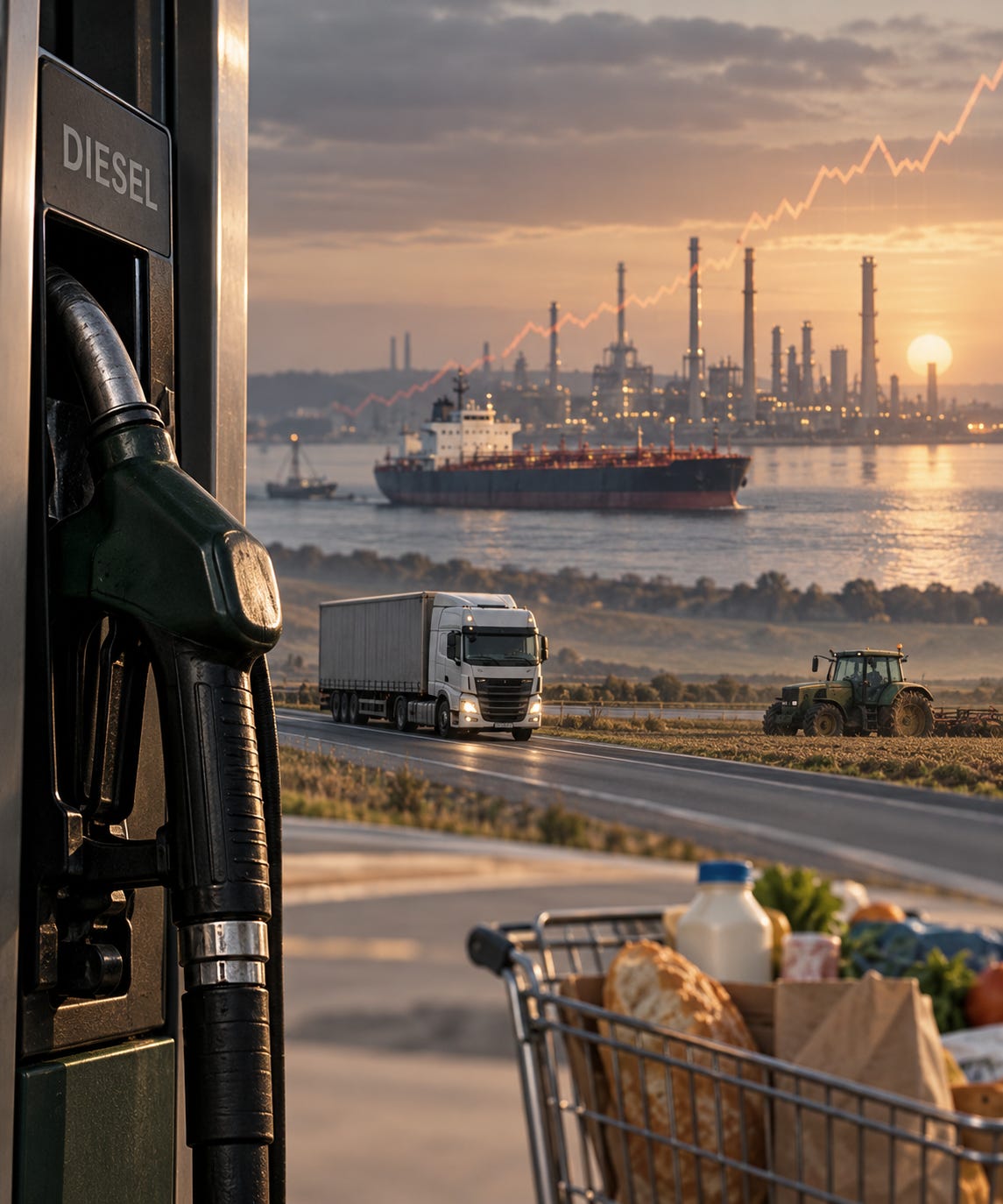
This week, diesel in Europe hit a new record. The EU average is now €2.24 a litre. In February, before the war with Iran began, it was €1.59. In the UK, it went over £2 a litre for the first time ever. Petrol is up almost 30% too.
Filling a 50-litre tank of diesel now costs around €112. That’s more than €30 extra, every single time.
This is an awful reality for so many people. The parent on the school run who has no other way to get there. The haulier filling up every morning. The farmer who can’t put off the harvest. The family heating their home with oil, watching winter come.
Prices spike all the time. Something happens, prices jump, and when things settle, they come back down. That’s what a spike is.
I don’t think this is one. The question I keep coming back to isn’t how high prices go. It’s how long they stay there. Here’s what’s behind it.
THE LESSON
Diesel is made in refineries, the plants that turn crude oil into the fuels we actually use.
Europe has substantial refining capacity, but it still relies on imported diesel to meet demand. That leaves it exposed when supplies elsewhere are disrupted.
For years, Russia was an important source of that imported diesel. After the invasion of Ukraine, Europe had to find new suppliers, including in the Middle East and the United States.
Then war disrupted the Middle East too.
In a normal spike, supply catches up. Here, there are three reasons it may not catch up quickly.
First, Europe has spent years losing refining capacity. Refineries have closed as fuel demand was expected to decline and the economics of running them became more difficult. That capacity can’t simply be switched back on when the market gets tight. Building new capacity takes years and enormous sums. Africa’s largest refinery, in Nigeria, took more than six years and over $19 billion.
Second, the war has disrupted energy infrastructure, shipping and trade across the region. Even when fighting stops, supply routes and markets don’t necessarily return to nor
mal immediately.
Third, emergency reserves are being used to cushion some of the disruption. But reserves don’t create new refining capacity. They buy time. And stocks drawn today eventually have to be rebuilt.
So even if the war ended tomorrow, which would help, it wouldn’t undo the vulnerabilities that were there before it began.
THE INVESTOR MIND
When prices jump, the natural instinct is to wait it out. Tighten things for a few months and assume it will pass. That instinct is often right, because many price jumps do pass.
But it’s worth asking a different question. Not how bad is this, but what would have to happen for it to end?
Here, part of the answer is refining capacity rebuilt, supply routes settled and reserves refilled. Not all of that happens in months.
A shock doesn’t create a weakness. It finds one. The war is the shock. Europe’s reduced refining capacity and reliance on imported diesel are part of the weakness it found.
THE AHA
Diesel still powers a big part of everyday life: freight, farming, buses, commercial vehicles and industry.
That matters, because a shortage can ease from the other side too. When prices rise, people usually find ways to buy less.
Diesel is harder. Lorries still have to move goods. Farmers still have to run machinery. Businesses still have deliveries to make. Demand can fall, but not always quickly.
So when supply is tight and demand can’t adjust easily, prices can stay under pressure for longer.
And that cost doesn’t necessarily stay at the pump. It can travel into deliveries, farming, manufacturing and eventually the price of other things we buy. That’s one way an energy shock can feed into inflation, the cost of living rising across the board.
When a price spikes, that ripple fades quickly. When the problem underneath takes longer to fix, it can last longer.
That’s not a spike. That’s a squeeze.
YOUR MONEY MOMENT
The Bank of England expects UK inflation to rise to around 3.75% by the end of this year, driven mostly by energy prices, especially motor fuels. In the euro area, energy prices in September were 18.8% higher than a year earlier, according to Eurostat’s first estimate.
I can’t tell you exactly how long this lasts. But I don’t need to know that to be ready for it. I’ve been following what’s behind these prices for a while, and I’ve thought carefully about how my own investments might behave if energy stays expensive for longer.
That’s what understanding gives you. Not a prediction. A head start.
So the question I’d ask isn’t about the pump.
Do you know how what you own might behave if inflation stays higher for longer than expected?
A spike, you can wait out. A squeeze, you need to understand.
Catherine x
Phase First.
Phase First is for educational and informational purposes only. Nothing here constitutes financial advice or a recommendation to buy or sell any security. All investing involves risk. I am a Fellow Chartered Accountant, not a regulated financial adviser. You are responsible for your own financial decisions.