


THE PHASE PULSE
Events in the Middle East this year have been devastating for countless people and families. That reality sits above any market observation, and it is important to say so.
But markets respond to the world around them. And what is happening in energy prices right now raises a question worth sitting with.
Inflation in the United States has just hit a three-year high. Petrol prices are up 30% since February. Fruit and vegetables are 6% more expensive than a year ago. The cost of living is rising — and it is being felt.
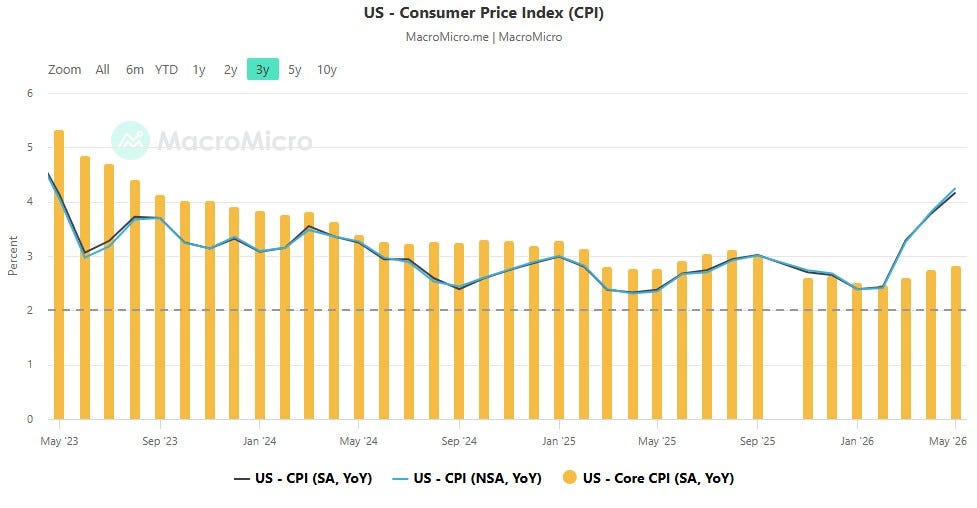
US Consumer Price Index — the spike you can see above is inflation hitting a three year high. Source: MacroMicro.me
The conventional explanation is simple: conflict disrupted oil supply, oil prices rose, and everything else followed.
But here is the question I keep returning to.
Was the supply already tightening before the conflict began? Were the conditions for this price environment already building — and did the conflict simply accelerate something that was already in motion?
That question is at the heart of how cycles actually work.
Events don’t create cycles. They reveal them.
THE LESSON
So what is a market cycle?
A market cycle — the repeating pattern of expansion, peak, contraction, and recovery that economies and markets move through over time.
Think of it like the seasons. Summer does not arrive because of a single event. It arrives because the conditions have been building — the angle of the earth, the accumulating warmth, the lengthening days. Winter does not end because of one warm afternoon. The cycle turns gradually, then all at once.
Markets work the same way. The conditions build quietly, beneath the surface, long before the headlines catch up.
Inflation rising is not the cause of a cycle change. It is a signal that you are already in a specific phase of one. The energy crisis did not create the conditions — it made them impossible to ignore.
This is why understanding the cycle matters more than watching the news.
The news tells you what has already happened. The cycle tells you where you are.
THE INVESTOR MIND
The investor who understands the cycle doesn’t need the headlines to tell them what’s happening. They already knew the environment was shifting. The headlines are confirmation — not a surprise.
That calm doesn’t come from predicting the future. It comes from understanding the pattern.
We will come back to this thread throughout the coming weeks. For now — just notice how differently you feel reading financial news when you have a framework versus when you don’t.
THE AHA
Every time prices rise, the conversation turns to who is to blame. Governments blame companies. Companies blame supply chains. Supply chains blame geopolitics. And the cycle turns quietly underneath all of it, largely unnoticed.
It was turning before the energy crisis. Before the headlines reached your morning news. Before the price rises showed up in your weekly shop.
The question worth asking now is not who caused this.
It is — where are we in the cycle?
YOUR MONEY MOMENT
Think about the last time a financial headline made you feel anxious.
Rising prices. A market drop. A warning about inflation.
Now ask — did you have a framework to read that moment? Or were you relying on the headline to tell you how to feel?
That gap — between reaction and understanding — is exactly what the coming weeks will begin to close.
Next week — now that you know markets move in cycles, the four phases themselves — and what each one means for the money sitting in them.
Catherine x
Phase First.
Phase First is for educational and informational purposes only. Nothing here constitutes financial advice or a recommendation to buy or sell any security. All investing involves risk. I am a Fellow Chartered Accountant, not a regulated financial adviser. You are responsible for your own financial decisions.
That's exactly why macro investors spend more time studying the transmission mechanism than the headlines.
Economic cycles begin with changes in liquidity, credit, and financial conditions. The news simply confirms what the data has been signaling with a lag. By the time the headlines change, markets have often already repriced.