


THE PHASE PULSE
September 2011. Gold at $1,921.
Twelve years of rising prices. Central banks buying. Debt everywhere. The story had never looked stronger.
The fall that followed did not happen overnight. It took years, and it did not move in a straight line.
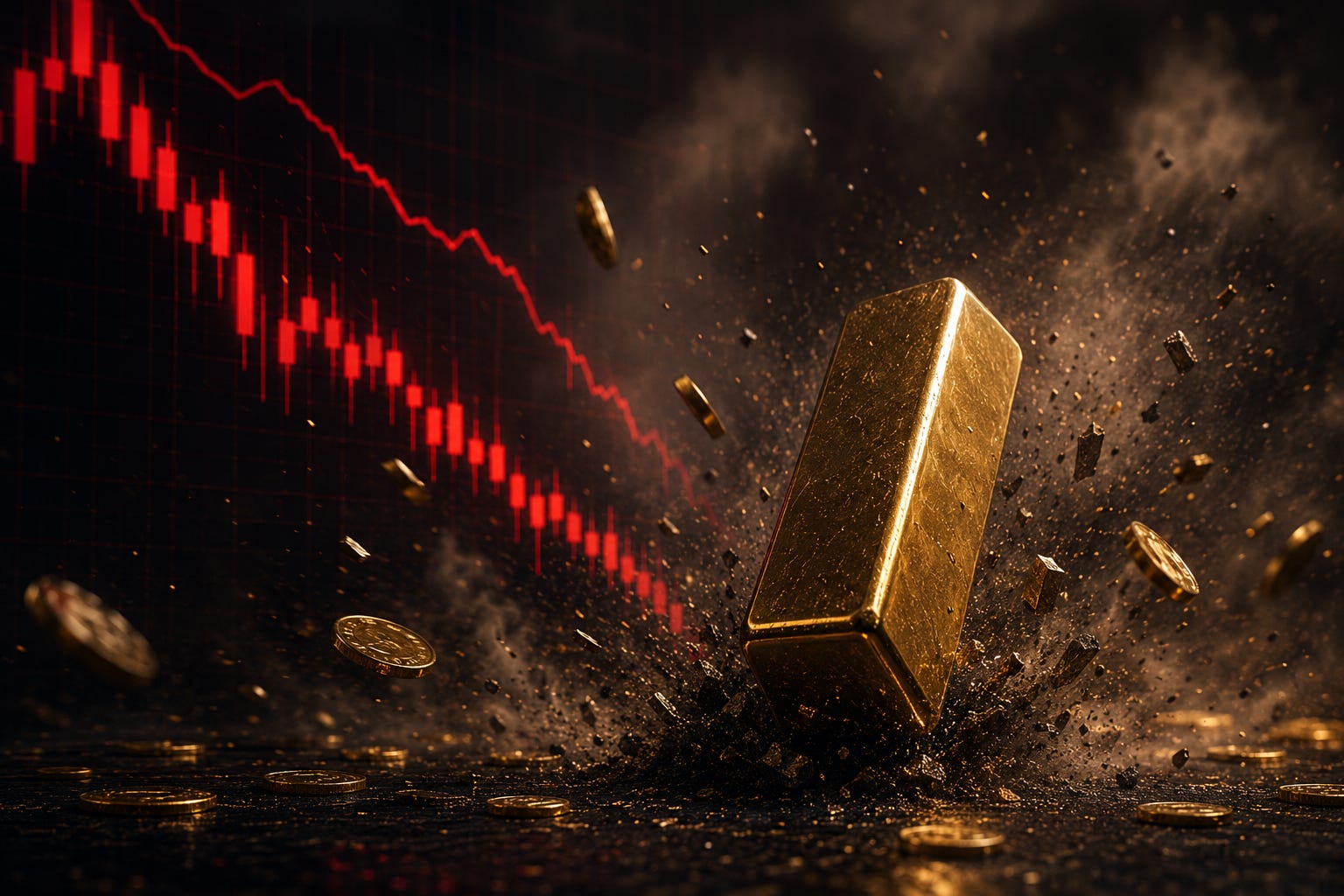
By December 2015, gold had fallen 46%, to around $1,049.
The debt did not disappear. It grew.
Central banks did not stop buying. Some of their largest purchases came in the years that followed.
Everything that had made gold feel essential in 2011 was still there in 2015.
And here is the question that took me years to properly understand.
If the debt was still growing, why did the price fall so far?
THE LESSON
Here is what actually happened. And it is more interesting than the price simply running out of steam.
Three things happened at the same time. None of them alone would have been enough. Together, they turned a twelve year rise into a four year fall.
The first thing. Almost everyone who wanted gold already owned it.
For a price to keep rising, new buyers have to keep arriving. Someone has to be willing to pay more than the last person did.
Through the Build years, there were always more people still to come. Early investors. Then institutions. Then central banks. Then, finally, everyone at the dinner party.
But by 2012, the people who believed in gold had largely acted on it. The queue of new buyers had thinned out.
The second thing. Early holders began taking profits.
Investors who had bought years earlier were sitting on enormous gains. At some point, a gain that exists only on paper becomes a gain you want in your hand.
Some began taking profits. Not in panic. Quite the opposite. Calmly, and by choice.
But that selling arrived at exactly the moment new buying was thinning. More gold for sale. Fewer people wanting to buy it.
The third thing. The conditions that made gold essential began to reverse.
Gold pays you nothing. No interest, no dividend, no rent. Its value comes from what someone is willing to pay for it, rather than income it produces while you hold it.
That is an easy trade to accept when savings accounts pay nothing either, and when money is being created on a scale that makes people question what their currency will be worth. Both of those were true after 2008. Gold gave up nothing, and it protected against something real.
By 2013, both of those supports were expected to weaken. The American economy was recovering. Equities began a powerful run. The dollar strengthened. And investors started to believe that interest rates, frozen near zero for years, would eventually rise again, and that the money printing would eventually stop.
Suddenly gold had competition.
Then came the sparks.
In April 2013, Cyprus was told by its European creditors to consider selling part of its gold reserves. Cyprus held barely enough gold to matter. But the fear was never really about Cyprus. It was that other struggling European countries, holding far more, might be forced to do the same.
A month later, in May 2013, the Federal Reserve signalled that its stimulus programme would eventually slow. This became known as the taper tantrum.
Neither event created the Breakdown. The conditions were already in place. These were the moments the market finally noticed.
Gold fell 28% that year, its worst annual performance in decades. The decline continued for two more years.
The Breakdown: the phase where the price falls, not because the reason to own it disappeared, but because the conditions supporting it changed.
In the Reset, few people own it, and the conditions are turning in its favour.
In the Breakdown, most people own it, and the conditions are turning against it.
Same asset. Opposite environment.
THE INVESTOR MIND
The Breakdown is where being right stops feeling like being right.
You can explain exactly why you own something. The reasoning is sound. And the price falls anyway, for months, then for years.
That is a specific kind of difficulty. Harder in some ways than being wrong, because being wrong at least makes sense.
And here is what makes it harder still.
A falling price looks identical whether your thinking was wrong or whether the conditions around it changed.
The price will not tell you which one you are in.
Understanding the phase is what helps you tell the difference.
THE AHA
Gold fell 46% between 2011 and 2015, while the debt it was supposed to protect against kept growing.
That only looks like a contradiction if you believe gold was pricing the debt.
It was not.
Gold was not responding to the level of debt alone. It was responding to the monetary conditions surrounding it. Cheap money. Near zero interest rates. A currency expanded to accommodate the borrowing.
Those were the conditions that made gold essential. And when they were expected to reverse, gold lost its support.
The debt was untouched.
The condition does not have to disappear for the phase to end.
The response to it only has to change.
This is the pattern that repeats. A story is true. The story stays true. And the price falls anyway, because what changed was never the story. It was the environment the story was living in.
YOUR MONEY MOMENT
Think of an investment you have heard described as a sure thing.
Ask what conditions are supporting it right now. Low rates. Cheap borrowing. Strong demand. Whatever they are.
Then ask what would have to change for those conditions to end.
The story tells you why an investment could rise.
The conditions tell you whether the environment still supports it.
You have now walked the full cycle. Reset. Build. Crowded. Breakdown.
Next week I show you the pattern that connects all four, and why you already understand it better than you think.
Catherine x
Phase First.
Phase First is for educational and informational purposes only. Nothing here constitutes financial advice or a recommendation to buy or sell any security. All investing involves risk. I am a Fellow Chartered Accountant, not a regulated financial adviser. You are responsible for your own financial decisions.