


The Phase Pulse
In January, gold hit a record high.
You probably heard about it. It was on the news, in the papers, in the group chats of people who never normally mention gold. $5,405 an ounce. A number nobody had ever seen.
Then it fell. Not dramatically, it just stopped going up, drifted sideways, and the conversation moved on. By spring, hardly anyone was talking about gold at all.
But something else happened in those same months, and it did not make the news.
The world's central banks bought 244 tonnes of it.
Not despite the fall. Through it. They bought more than they had the previous quarter, and more than their five-year average. And in June, a survey of the people who manage those reserves found that 89% expect to keep buying.
So which one is the story? The price that went quiet, or the buyers who never stopped?
They are two different things. And this week is about the difference.
The Lesson
Last week we saw that markets move in cycles, that conditions build long before events announce them.
This week: what those cycles actually look like.
A market cycle has four phases. Four repeating stages that markets move through, in order, again and again.
The Reset. The asset is quiet. Prices are low, attention is elsewhere, and nobody is recommending it at dinner. It still exists. It is simply out of season, and the people who are not watching have stopped noticing it is there.
The Build. Conditions start to change. Money moves in quietly. Not headlines yet, just flows. Prices begin to lift. It is the least dramatic phase and the most consequential, because almost everything that happens later is decided here.
The Crowded. Now everyone knows. It is on every screen, in every conversation, and the story is repeated so often it stops sounding like a story and starts sounding like a fact. By now attention is everywhere, and prices have usually risen a long way too.
The Breakdown. The conditions that supported it fade. Money leaves, and attention follows, usually in that order. And then, eventually, it is quiet again. Back to the Reset.
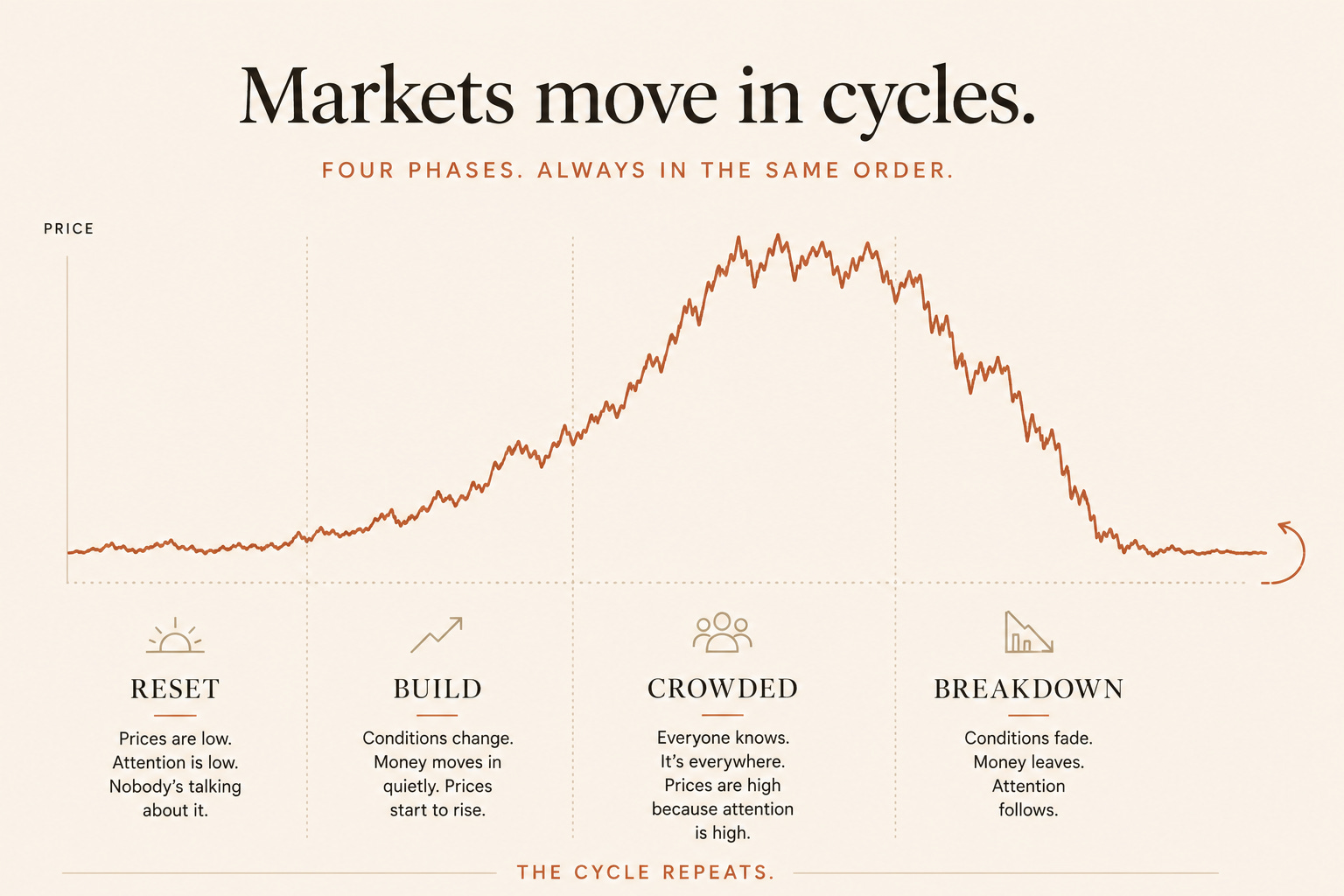
Four phases. Always in that sequence.
One thing worth knowing straight away: nothing moves through a phase in a straight line. A market in the middle of a long rise will still have weeks where prices fall, and months where price goes nowhere at all. Those are pauses inside a phase, not the end of one.
THE INVESTOR MIND
Knowing the four phases is the easy part.
The hard part is that you never get a label. No alert tells you a Reset has become a Build, or that a Crowded phase is running out of room. You are always standing inside one without a sign on the wall.
Which is why the phases are not really about prediction. They are about not panicking at the wrong moment. Not mistaking a quiet phase for a dead one, or a loud one for a safe one.
The calm investor isn’t calm because she predicted what came next. She is calm because she knows where she is now. You cannot control what the market does, but you can know which phase you are in. That is what keeps you steady.
The Aha
The price of gold fell. The buyers who hold it for decades kept buying.
One of those is weather. The other is season.
Most of us learn to watch prices. We never learn to ask what phase those prices belong to.
That’s why a falling price can feel frightening. We don’t know whether it’s a normal pause within a phase or the start of a new one.
A price tells you what happened today.
A phase tells you where you are.
Once you understand the phase, the number on the screen becomes one piece of information, not the whole story.
Your Money Moment
Think of the money you have invested right now — the fund, the pension, the account you check occasionally.
Do you know what phase it is in?
Not what it did last month. What season it is in.
You would never choose a serum without looking at your face first.
Nobody ever told you your money had a face to check too.
Next week — the Reset. The phase nobody notices, and the one that decides the most.
Catherine x
Phase First
Phase First is for educational and informational purposes only. Nothing here constitutes financial advice or a recommendation to buy or sell any security. All investing involves risk. I am a Fellow Chartered Accountant, not a regulated financial adviser. You are responsible for your own financial decisions.