


THE PHASE PULSE
Last week, capital rotation moved through a supply chain. AI needs chips. Chips need factories. Factories need materials. Materials need mining. Everything needs energy.
This week, the same thing — at the scale of governments.
Tavi Costa, one of the most respected macro analysts in the world, published a chart this week that stopped me in my tracks. Foreign governments now own the lowest share of US Treasuries in history. In 2008 they owned roughly 35% of all US government debt. Today that number has fallen to 12.5%.
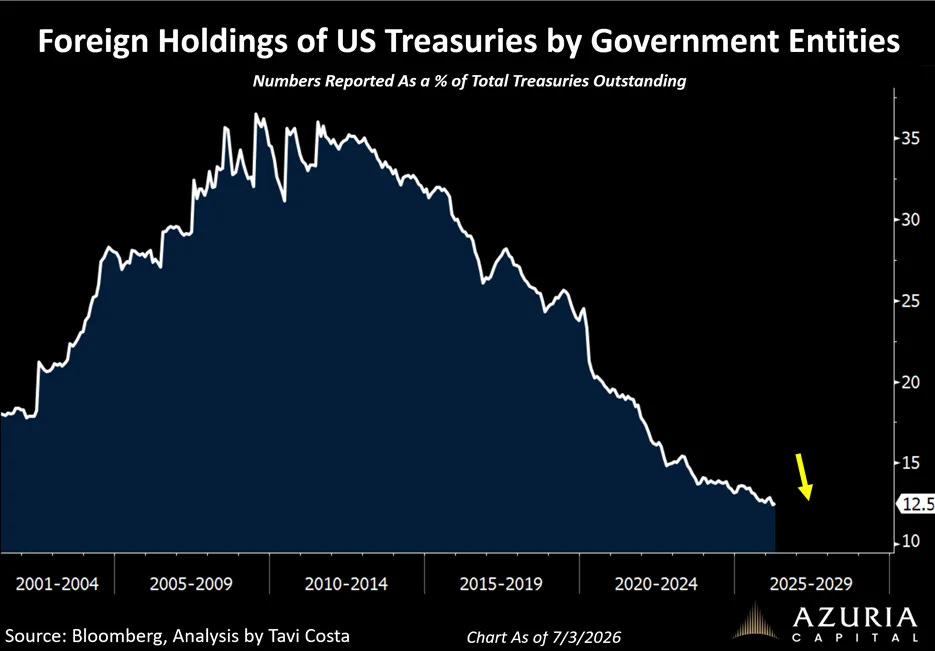
Chart: Tavi Costa, Crescat Capital — tavicosta.substack.com
That is not a small shift. That is a twenty year rotation playing out in one of the most important markets on the planet.
And almost nobody is talking about what it means.
THE LESSON
First — what is a US Treasury?
When the American government needs money, it borrows it. It does this by issuing bonds called US Treasuries. A bond is simply a loan. You lend the government money. They promise to pay you back with interest after an agreed period of time.
For decades, foreign governments — China, Japan, Saudi Arabia, and others — bought enormous amounts of these bonds. It was considered one of the safest investments in the world. You were lending money to the United States. What could go wrong?
But that is changing.
Foreign governments are now buying far fewer US Treasuries than they used to. The share they own has fallen from 35% to 12.5% over twenty years — and it is still falling.
So the question is — where is that money going instead?
That is capital rotation.
Capital rotation — when large amounts of money move from one type of asset into another, following shifts in the global environment.
For twenty years the environment rewarded financial assets. Stocks. Bonds. US debt. Paper promises.
Something is shifting.
When governments stop buying bonds, that money has to go somewhere. Historically, when confidence in paper assets falls, capital moves toward hard assets — things with physical value that exist regardless of what any government decides.
Gold. Commodities. Real assets. Energy. Land.
How far that shift runs, nobody knows. But it is already twenty years in the making — and it is still moving.
THE AHA
For the last fifteen years the advice was simple. Put your money in a broad fund. Leave it alone. Trust the long run.
That advice was built for a specific environment. An environment where financial assets were winning.
That environment is changing. Not overnight. Not in a crash. Slowly — the way all big things change.
And it is the kind of change you can only see if you know to look.
YOUR MONEY MOMENT
Your money is sitting somewhere right now.
Probably in financial assets. A pension. A tracker fund. Savings.
Ask yourself — was that decision made for the environment we are in today?
Or was it made for the environment of ten years ago?
Next week — there is a framework that explains exactly how markets move through environments. It has four stages. Once you understand them, you will never look at a market chart the same way again.
Catherine x
Phase First.
Phase First is for educational and informational purposes only. Nothing here constitutes financial advice or a recommendation to buy or sell any security. All investing involves risk. I am a Fellow Chartered Accountant, not a regulated financial adviser. You are responsible for your own financial decisions.